Sunday, April 10, 2011

Evelyn on My Mind

This coming Passover/Easter will mark sixteen years since my mother-in-law, Evelyn Reed, passed into spirit. It’s hard to believe that it has been so long. Even as recently as October, when I was in Chicago, I half-expected to see her. She was a single mother who raised four children under dangerous and stressful conditions in the ghetto in Chicago. Despite living in circumstances not supportive of family life, my husband and his siblings grew up in a large and loving family that provided a lot of laughs and nurturing. Mama was one of the most generous people I have ever known. She manifested Do Unto Others. Although Mama worked hard to support her family (for many years she was a mail carrier for the postal service), she lived in poverty her entire life. It’s easy to be generous when you have money, but it’s another story when you have next to nothing. Whatever Mama had, she shared. Anyone who turned up at her door hungry was fed, no matter how bare her pantry was.

During the years that I knew her, she lived in a duplex that she owned on the South Side of Chicago. My sister-in-law lived upstairs with her family and my brother-in-law shared the downstairs with Mama. When I first met her, Mama had her mother living with her as well. When I was seven months pregnant with my first child, Ron and I went to visit Mama for Christmas. We arrived to discover that Mama’s younger sister and her five children were living with Mama. Her sister had left her husband (who had been abusing her) and she had nowhere to go, so Mama took her in. Mama probably saved her life. The children slept on the couch and chairs in the living room every night. While we were visiting, we slept in my brother-in-law’s room. I have no idea where he slept during our visit. The ten of us shared one bathroom. The kitchen was tiny, but it served well enough for us to cook up a delicious Christmas dinner. There were few gifts exchanged, but much time spent together as a family . The greatest gift of all. It was a memorable visit and a terrific Christmas.

Her sister was not the first nor the last to find respite in that house. I could not begin to count all the people who lived there at one time or another. Mama felt fortunate to have a house, making it possible for her to lighten the burden for others with nowhere to go. It was one of the ways in which she served God. When we called Mama, we never knew who would answer the phone because she was constantly taking people in to stay with her. I remember calling once and talking to an elderly woman whose locks had frozen on her house in the bitter Chicago winter. She couldn’t afford to fix the problem, so she left the house locked up until the spring thaw and moved in with Mama in the interim. Despite Mama’s poverty, she regularly gave a tithe to her church to support church activities that provided services for people in need. In the later part of her life, when she had become an elder in the church, many people relied on her to give them guidance, spiritual and emotional support, and encouragement. She never judged others. She was compassionate and a good listener. She enlisted the healing power of laughter as one of her chief assistants and she needed that sense of humor to cope with the huge whacky family and the ridiculous (and at times incredibly absurd) situations she and her relatives found themselves in because of their lack of money and resources.

In the spring of 1995, Mama had a heart attack and was hospitalized for a couple of weeks. The doctors readjusted her medications and sent her home. To this day, I believe that she was killed by racism and poverty and that if she had been a middle class white man, the doctors would have recommended bypass surgery and would have been more aggressive about saving her life. On Easter Sunday we were at my parents’ house with our children for Passover and we called Mama. Everyone spoke to her. Me. Ron. The children. My mother. Ron talked to her for a long time and they laughed a lot. When he thinks of her voice, he can still hear that laughter from the last time they spoke. Two days later she had another heart attack. She was 62. Because no ambulance service would go into Mama’s dangerous neighborhood, she could not call 911. Dear friends were driving her to the emergency room when she died in the back seat of their car, lying in the arms of one of them. The last thing she said was, “I love you.”

So many people came to her funeral that they couldn’t all fit into the church. Many of those who couldn’t get inside stood outside in the street for hours. The police came and officially closed the street because it was filled with people. So many people went up to the pulpit to speak about her or to sing that the service went for more than six hours (past midnight). Every year, I light a yahrzeit candle (Jewish memorial candle) for Mama on the Tuesday after Easter Sunday. I suppose there is a poetic irony in the fact that a Jewish woman lights a yahrzeit candle every year for an Apostolic Christian Black woman from the South Side of Chicago. There is a directive in the New Testament that says “Bloom where you are planted.” Mama, you were the most exquisite flower. Still missing you.


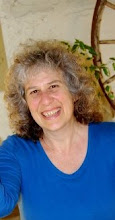
Me and my mom with Evelyn during an outing (photo by Ron).

Sunday, April 3, 2011

My Tribe

This past week I met with tribal leaders of a local Pomo tribe with whom I am going to work on a grant proposal. Our meeting sparked me to think about tribes and land, indigenous people, and having one’s ancient homeland robbed by invaders. I come from a native tribe that was forced into exile thousands of years ago. Recently, within the past one hundred years, my tribe, by a miracle, was able to reclaim a small sliver of our land. It wasn’t the part of our original land that was arable or rich with resources, much like the land to which many Native American tribes have been relegated. Hardly anything would grow on it. In fact, it was mostly desert. But my tribe worked to make the land yield food and flourish against all odds. I have chosen not to return to my ancestral land. Like many native peoples who have been separated from their tribal land for generations, I was not born on the land and it does not feel like home to me. Those of my tribe who returned and settled there have clung to the land fiercely. Many countries and peoples throughout the world would like to take that tiny piece of land away from my tribe again. My tribe, of course, is the Tribe of the Hebrews and our ancestral land is Israel.

Like many Jews and many progressives, I am deeply disappointed by the way the Hebrews have conducted business and government, by the violence perpetrated against the Palestinian people, the oppression. I would have liked to think that my tribe would have acted with patience, grace, tolerance, compassion, and generosity. I would have liked for my tribe to stand out as a beacon of justice and an exemplary nation. After all the oppression, persecution, and horror that my tribe has experienced during the decades of our exile, I hoped that we would be incapable of visiting such oppression and persecution on others. I expected it. However, despite my deep disappointment (at times horror) at what my tribe has done with its nationhood, I have never questioned the right of my tribe to exist as a nation on our ancestral land. Many countries have behaved as badly or worse than Israel and yet no one questions their fundamental right to exist as a nation. South Africa under apartheid. Nazi Germany. Bosnia. Libya. Hussein’s Iraq. Pinochet’s Chile. Rwanda. El Salvador. Afghanistan. Horrific things happen in nations throughout the world every day; and compassionate, moral people oppose these horrific things. Sometimes giving their lives to oppose these horrific things. But in all of this, the right of these nations to exist is not questioned. So I must ask, why is Israel’s very right to exist questioned? Why is it politically correct in the progressive community to support the return of tribal lands to other indigenous peoples, but not to mine?

Sunday, March 27, 2011

Why Do I Blog?

It has been quite a few years now since I started blogging. Hardly anyone reads my blog. Maybe a dozen people on a good week, and most of you are close relatives or longtime friends. So why do I do it?

One very good reason is that as a working professional writer, it’s simply a good workout to produce a weekly column. Some weeks I put more energy into it than others. For awhile, a few years ago, I tried to write a funny blog every week. Wow was that exhausting! Humor is much harder work than serious prose. But no matter the style or topic, the mental and creative exercise of writing a short piece each week is a discipline to which I am committed.

Another reason why I blog is that, as a writer, I am compelled to communicate in words. Writing the blog fulfills my crazy need to send my words into the world. Blogging helps me cope with the fact that my books are not published. It feels like someone (even if just a handful of die-hard folks who care about me) is reading my words. I feel vaguely or occasionally useful. If I give someone a laugh or an insight, a shred of information or a moment of recognition, then my craft has purpose.

The thing I like the most about blogging is that my words are out there in cyberspace somewhere. So I have the sense (albeit an illusion, yet comforting) that even if I dropped dead this minute, my words would continue to live forever. Or at least for as long as there are satellites circling in orbit and the physics of life as we know it continues. Last year one of my good friends was following the blog of a woman who was dying of Lou Gehrig’s Disease (or ALS). The woman was a performing artist. Before she got sick, she cut several jazz CDs. She had a beautiful voice. She also wrote drama, acted, and directed. She did stand-up comedy. Someone made a documentary film about her and her performances and the progress of her illness. She lost her fight with ALS last year. Many artistic tributes to her life and her genius remain in the form of recorded music and recordings of live performances she did, as well as that documentary film. But perhaps the one thing she produced that will stand out as her greatest contribution was her blog. She blogged for several years while she was dying. And the blog was funny and tragic and a window into her world and a testament to the awesome strength of the human spirit. I have heard several people say that when they discovered her blog, they went back and spent hours reading the whole thing from the beginning. She is gone, but her words remain. People can find her and get to know her even though she is no longer among the living.

So maybe I ascribe to that fantasy. If I died tomorrow, the books I have written that remain unpublished would never go out into the world. All those lost words, lost hours. It frightens me. So I blog. At least a handful of my words, and maybe not even those that I have put the most energy and thought into, but something, will live in the mysterious ether of cyberspace for a time. It comforts me to know that a few of my words are wandering in the wide world where they might perhaps connect with people I have never met.

Monday, March 21, 2011

Wall Street Still Selling Snake Oil to Main Street

In 2010 the Obama Administration pushed through Congress the Dodd-Frank financial reform bill, which has the policing power to regulate Wall Street shenanigans and actually put financial executives in jail. But the Republican-controlled House is quietly destroying the bill under the guise of “budget cutting.” They’re determined to defund this first semblance of real policing of financiers who are trashing the economic infrastructure.

The Dodd-Frank Bill boosted the power of the SEC and the Commodity Futures Trading Commission (CFTC) to regulate derivatives trading, which is what caused the economic tsunami to begin with. Derivatives trading was, in a nutshell, all that betting made by investors that bad mortgages would fail (and they did, as expected by everyone except the regular folk who were conned into signing on the dotted line to finance their homes with them). The Dodd-Frank Bill also set up a new agency, called the Consumer Financial Protection Bureau (CFPB), to protect consumers from creepy mortgage salespeople and greedy credit card companies. These regulatory agencies (i.e., the CFTC and the CFPB) need to expand their payrolls to function properly, and the Republican House has apparently wiped the needed money from the federal budget. The Tea Party wants less government interference in business, so they are happy to see these regulators underfunded. As Barney Frank said, the Republicans in the House are “letting Wall Street off the hook.” It’s pretty obvious to me who is actually trying to clean up Wall Street and who is trying to keep anything from changing.

I heard a joke last week that went like this: A corporate CEO, a Tea-Partyer, and a union organizer are sitting at a table on which there is a plate with a dozen cookies. The CEO takes 11 cookies, pockets them, and then turns to the Tea-Partyer and says, “That union guy is trying to take half of your cookie.”

[To my handful of devoted readers: I apologize for posting a day late. We had huge weather over the weekend in Mendocino County and our power went out Saturday night and is still out. I have gone to Ron's office to work and have internet access.]

Sunday, March 13, 2011

Tsunami Thoughts

My youngest, Sudi, called me yesterday and we went online together and watched aerial video footage of the Tsunami making landfall and destroying a city. The hair on the back of my neck stood up; and as buildings and vehicles were swept away like matchsticks, Sudi kept murmuring “whoa” in transfixed horror. Afterward, we spoke about building a career around a creative passion, among other things. I had barely hung up with Sudi, when his brother Akili called and we went online and watched the same aerial video footage together, with the same transfixed horror. Akili is recovering from a broken ankle and he lives two miles from the ocean. “Mom,” he said, “I would be dead if a Tsunami struck here right now. I wouldn’t be able to get out in time. My best bet would be to climb to the roof of my apartment building.”

We live in California, another earthquake hot spot. My children live in close proximity to the ocean. After all, Ron and I raised them, and being near the ocean is a spiritual necessity for us. For many years, my greatest fear in every substantial earthquake I experienced has not been the fear of being crushed in rubble or drowned in a Tsunami. It has been the fear that a nuclear power plant somewhere has been destabilized, which is exactly what happened in Japan where radiation is now leaking into the atmosphere from a nuclear reactor core meltdown. Nowadays, my greatest fear of course is for the safety of my children.

From the time the earthquake struck to the time the first Tsunami wave made landfall was between 10 and 15 minutes, depending on the location. I wonder how far I could drive in 10 minutes in such an event. If I lived two miles from the ocean (as Akili does), and I jumped in my car and drove East immediately after the earthquake, could I get far enough inland to be safe? Would the roads be passable? Would they be destroyed or mobbed with traffic, making it impossible to escape? It would take 10 minutes just to collect my computer, my photo albums, and my two cats, and throw them in the car. (That is if I could find my cats. Would they have a better chance of survival in or out of a cat carrier?) What would it feel like to walk away from everything I own? Have I secured the manuscripts of all the books I have written electronically in a remote location so they would be safe?

As I continue to follow the news and send my thoughts and prayers to the people of Japan, it all seems far away. I am removed and safe here in my inland home. But not as removed as all that. I remember when the December 2004 Tsunami struck Phi Phi and within 24 hours of the disaster, my friend Derek called me from Denmark to tell me that our mutual high school friend Stephen was vacationing in Phi Phi. Stephen’s wife Heather was swept out to sea and drowned. Stephen survived by clinging to the upper branches of a tree in which he became tangled. He was so badly injured that he spent several weeks in the hospital in Phi Phi before he could travel home to London, accompanied by a nurse. I telephoned him upon his return. Not so removed.

The question that haunts me in the aftermath of this week’s Tsunami is: How can I make better use of my life?